






Charting a New Course for Patients with Kidney Disease
Estuary is on a mission to make ADPKD history.
ADPKD is one of the largest unsolved monogenic diseases.
Autosomal dominant polycystic kidney disease (ADPKD) is the most common inherited kidney disease in the world. ADPKD is inherited, lifelong and progressive.
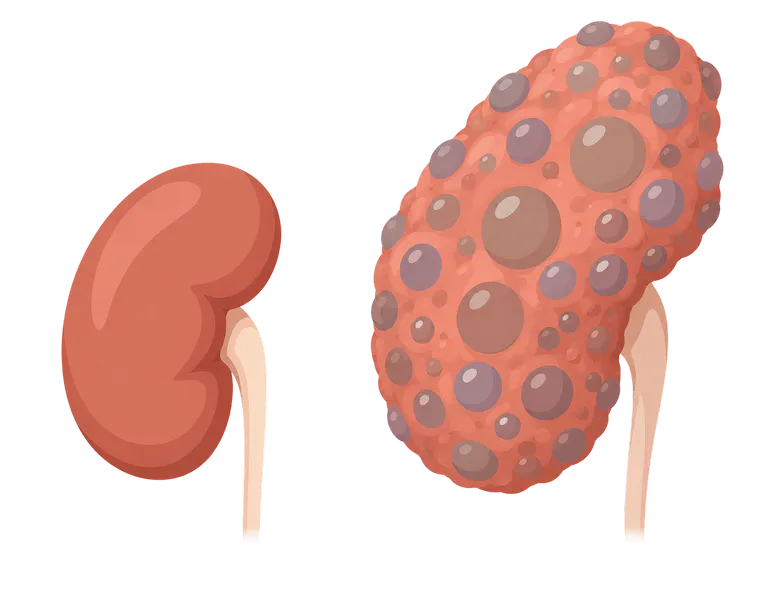
Cysts form in both kidneys and enlarge over decades, displacing functioning tissue until the organ fails. For patients with rapidly progressing ADPKD, they will experience end-stage kidney disease (ESKD) within their lifetime.
- 8MM+
- people with ADPKD globally (1:1000 prevalence)
- >90%
- of patients carry a mutation in PKD1 or PKD2
- 4th
- leading cause of ESKD — kidney failure requiring dialysis or transplant
- 45-65
years - average age of ESKD for patients with rapidly progressing ADPKD
- $7B+
- annual direct cost of ADPKD care in the US
Fit-for-purpose therapies.
Designed to drive transformative benefit.
We believe that our approach can offer the ultimate solution for patients with ADPKD: halting or reversal of disease, not merely slowing decline.
Mechanism of action
We are treating ADPKD at the root cause: using AAV gene therapy to add back a healthy copy of the PKD2 gene or a functional region of the PKD1 gene, counteracting the effects of the inherited gene mutation. In preclinical models, polycystin restoration has been shown to drive transformative disease resolution across both structural and functional outcomes.
Local delivery
Estuary has pioneered a delivery approach tailored to the unique biology and accessibility of target kidney cells, enabling local and direct delivery of genetic medicines. By blazing this new path, the company intends to avoid common pitfalls that have impacted prior gene therapy programs.
High-leverage pipeline
Estuary’s programs share common features across route of delivery, target cell type, AAV capsid and precision clinical development strategy – driving significant leverage and efficiency from EST-201, the first program, to all subsequent ones.
Pipeline
EST-201
ADPKD-PKD2- Discovery
- Preclinical
- Clinical
- ⠀
A full-length PKD2 gene-addition therapy delivered via AAV.EST-101
ADPKD-PKD1- Discovery
- Preclinical
- Clinical
- ⠀
A gene-addition therapy delivering a PC1-derived functional region via the same AAV serotype as EST-201. This novel sequence can be packaged into AAV, unlike full-length PKD1.EST-102
ADPKD-PKD1- Discovery
- Preclinical
- Clinical
- ⠀
Additional Opportunities
- Discovery
- Preclinical
- Clinical
- ⠀
Estuary’s kidney delivery platform may be amenable to the development of programs targeting both monogenic and common forms of kidney disease.
Team
Backed by
Contact us
General
Business Development
Investors and Media